Listen · 2:58 Écouter · 3:11
0:00 / 2:58
The legend of the Sciegouine of the seas is a fascinating creation of Quebec’s maritime imagination, particularly tied to the Gulf of Saint Lawrence. It describes a fabulous creature, resembling a giant sawfish, said to have haunted the cold waters of Canada. This legend perfectly illustrates how sailors, confronted with the vastness and mysteries of the sea, often interpreted natural phenomena or encounters with unknown animals as supernatural apparitions.
Mingan Islands
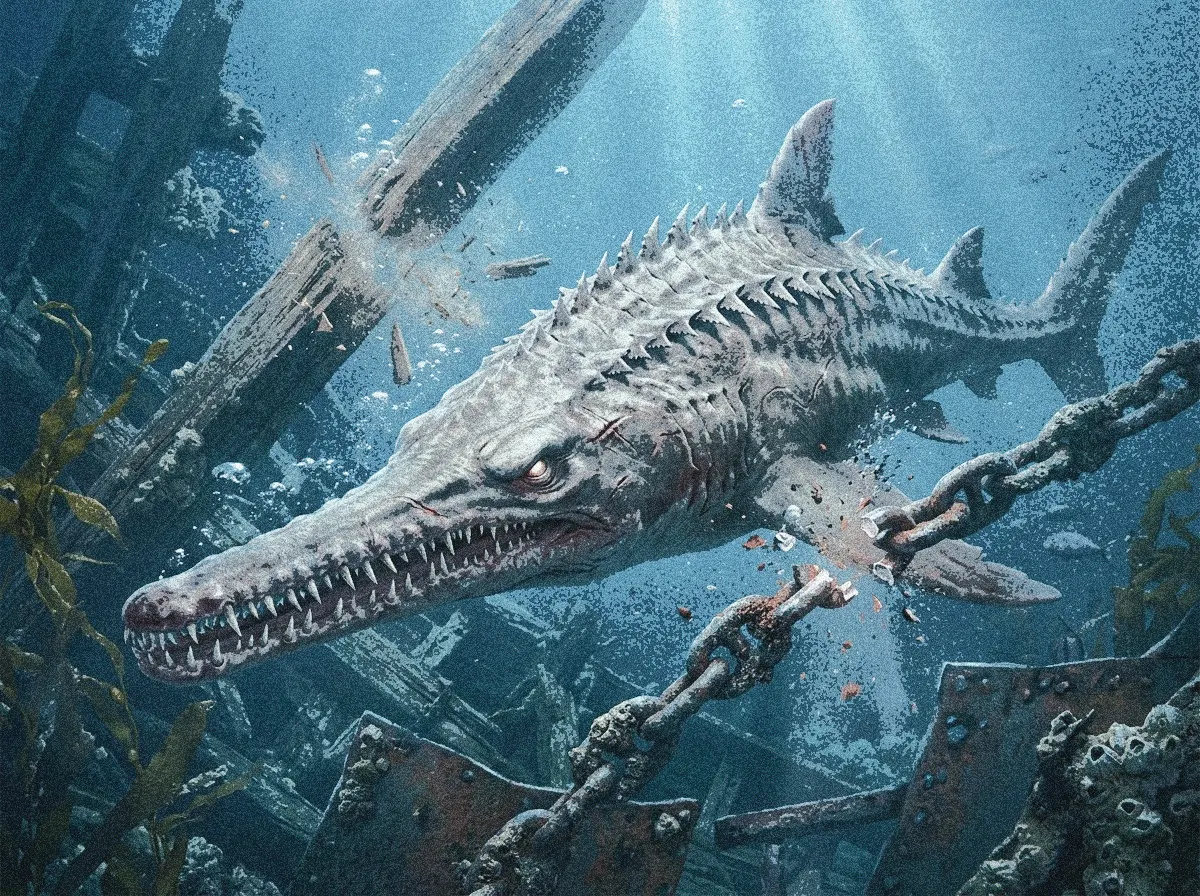
No monster was feared more by canoeists than the “Sciegouine of the seas,” a kind of sawfish covered in teeth along the top of its body, capable of cutting through wood and iron. This fabulous fish would slice boats clean in half, leaving the men floundering in the water.
Its appearances date back centuries, as the first Europeans crossing the seas toward America reportedly encountered it as early as the 17th century. The Sciegouine would arrive at high speed, always in a straight line, its back bristling with teeth that left a white streak on the water. It would dart past the front or rear of a vessel like a comet. Immediately, the sailors would shout: “Watch out, there’s a Sciegouine of the seas lining up its sights!” And quickly, they would turn the boat to face the creature’s path, because it was well known that this dangerous fish never made more than three passes before attacking a vessel. If it failed to strike during those passes, it would vanish into the depths.
When a Sciegouine succeeded in its attack, it would leave without harming other nearby boats. But there was a time when escaping was nearly impossible, as Sciegouines sometimes attacked in groups. This was suspected when the remains of two or three vessels were found after a single massacre. Sadly, no living soul remained to tell the tale of what had occurred.
The last known appearances of the Sciegouine occurred during Prohibition, around 1918, when smugglers were trading alcohol with the people of Saint Pierre and Miquelon. Several captains were hired to transport jugs of strong liquor from those islands but never returned with their cargo. Other captains would bring the bad news to the waiting clients: “It’s terrible,” they’d say, “what happened to them. At the entrance to the gulf, they encountered a Sciegouine of the seas that shredded their boat to pieces, and the entire shipment was lost to the sea.”
La légende de la Sciegouine des mers est une fascinante création de l’imaginaire maritime québécois, particulièrement liée au golfe du Saint-Laurent. Elle décrit une créature fabuleuse, semblable à un poisson-scie géant, qui aurait hanté les eaux froides du Canada.
Cette légende illustre bien comment les marins, confrontés à l’immensité et aux mystères de la mer, ont souvent interprété des phénomènes naturels ou des rencontres avec des animaux inconnus comme des apparitions surnaturelles.
Les îles Mingan
Les canotiers ne craignaient aucun monstre autant que la « Sciegouine des mers », sorte de poisson-scie pourvu de dents sur tout le dessus de son corps et capable de trancher le bois et le fer. Ce poisson fabuleux coupait les embarcations d’un bord à l’autre par le milieu et les hommes se retrouvaient à l’eau.
Ce n’est pas d’hier qu’elle fit son apparition, puisque les premiers Européens qui franchirent les mers en direction de l’Amérique la rencontrèrent dès le XVIIe siècle. La Sciegouine s’amenait à grande vitesse, toujours en ligne droite, le dos hérissé de dents qui traçait une raie blanche sur l’eau. Elle commençait par filer comme une comète en passant juste à l’avant ou à l’arrière de l’embarcation.
Aussitôt, les mariniers criaient : « Attention, v’la une scieguoine des mers qui prend ses mire ! » Et rapidement, ils redressaient l’embarcation pour lui mettre le nez dans le sens des passages de la sciegouine, car c’était connu : ce dangereux poisson ne faisait jamais plus de trois allers-retours pour s’attaquer à une embarcation. Si la sciegouine ne réussissait pas à l’attraper sur son trajet, elle disparaissait dans les profondeurs des eaux.
Lorsqu’un « Sciegouine » atteignait son but, elle repartait sans s’en prendre aux autres embarcations témoins de son passage. Mais il fut une époque où il était presque impossible de s’en défaire, car les sciegouines attaquaient à plusieurs à la fois. C’est du moins ce que l’on supposait lorsque les restes de deux ou trois bâtiments furent retrouvés après un même carnage. Malheureusement, il ne restait plus âme qui vive pour en témoigner.
Les dernières fois que la sciegouine s’est manifestée, c’est durant la Prohibition, vers 1918, alors que des contrebandiers faisaient le commerce de l’alcool avec les gens de l’île Saint-Pierre-et-Miquelon. À plusieurs reprises, des capitaines payés par des trafiquants pour transporter des caisses de boissons fortes ne revinrent jamais avec leur chargement. D’autres capitaines ramenaient alors la mauvaise nouvelle à celui qui attendait sa marchandise : « C’est bien terrible », disait-il, « ce qui leur est arrivé. À l’entrée du golfe, ils ont rencontré une sciegouine des mers qui a débité leur bateau en morceaux, et tout le chargement s’est perdu dans la mer. »