Listen · 4:26 Écouter · 4:14
0:00 / 4:26
The legend of the Black Komatik, told in Tête-à-la-Baleine on Québec's Lower North Shore, is a local story passed down orally. It forms part of the intangible heritage of this remote region, where tales are often shared from generation to generation—around the fire or during evening gatherings.
It sometimes describes the appearance of a ghostly sled gliding alone across the ice, often just before a storm or a mysterious disappearance. Considered a bad omen, it is surrounded by a taboo: never follow its tracks, for they are said to lead to a world of no return.
The “bonne femme Charlie” of Tête-à-la-Baleine appears to be a local figure mentioned in oral stories from the Lower North Shore, but there are currently no official bibliographic or historical sources that clearly document her identity or role in the village's legends. She may be part of the regional folklore, passed on by word of mouth—like many mysterious or emblematic characters that inhabit the stories of this isolated community.
Tête-à-la-Baleine
Whenever the old fishermen told scary stories, there was always one who ended up saying: “They say that when they buried old Charlie's woman, there was nothing left in the grave.”
She was a big, heavy woman who sold booze and had lived her life without ever practicing religion. Even the men who went to see her for a drink were afraid of her. She spoke loudly, and when the men “got out of line,” she “put them back in their place.”
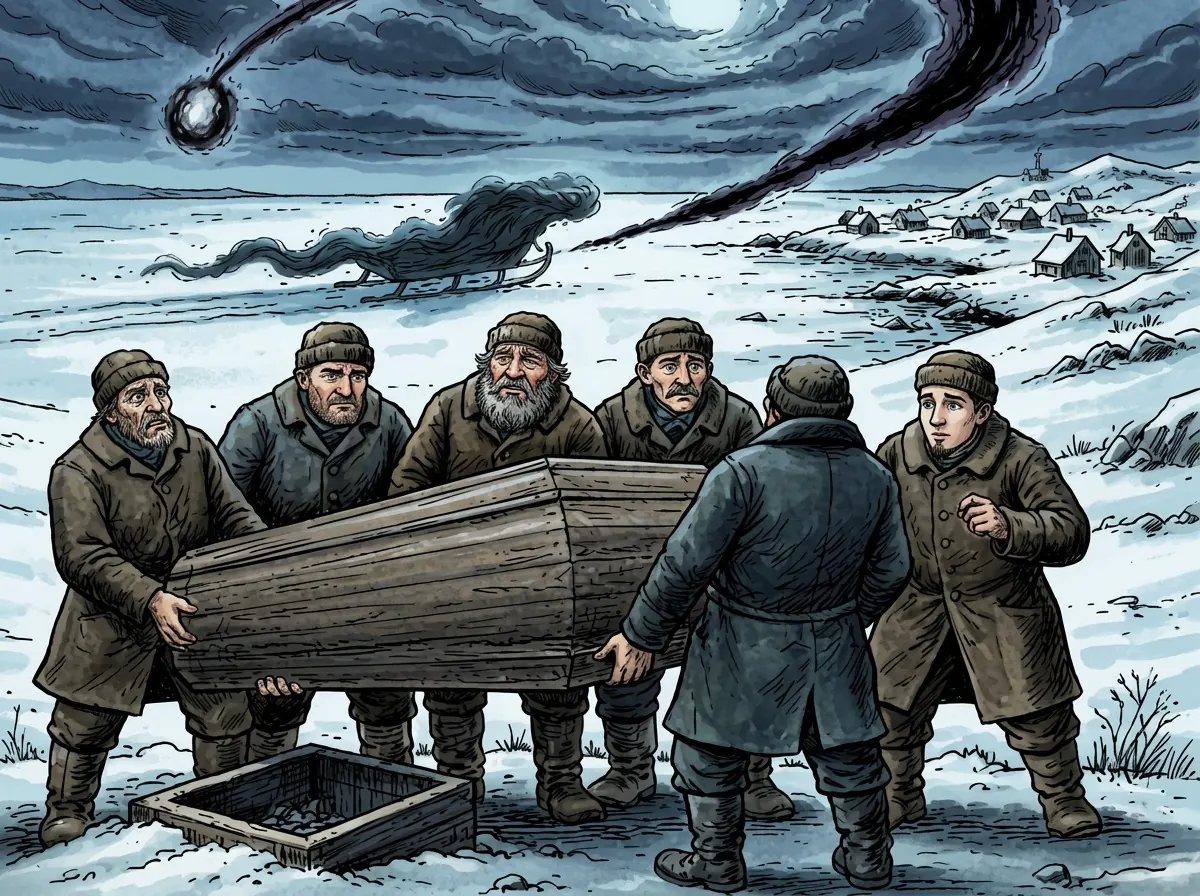
One fine day, the coastal folks heard that the old woman had died. Ha! That didn't sit well with those who used to visit her. They chose six “strong men,” capable fellows, because they had to carry the coffin two miles away, where there was enough earth over the rock to bury her.

When they got there, they gave themselves a push to lift the coffin—but surprise! The grave was empty! Not one of the pallbearers dared say a word; each one thought the others were carrying all the weight. They went ahead with the burial as if nothing had happened, but on the way back, the pallbearers realized they had all understood that the woman was no longer in the coffin.
But the story doesn't end there. That very evening, two hunters walking on the ice along the bay saw a large black komatik sled coming toward them, driven by a man dressed entirely in black who wasn't from around there. Then they saw, tied to the komatik, a red sleigh in which a large person was lying down.
It was heavy, because the black dogs pulling the sled had their tongues hanging out and sweat glistening on their bodies. The two hunters didn't say a word—they were scared and hid behind some rocks. When the sled disappeared behind a patch of little Saint-Michel trees, the bolder of the two hunters wanted to step forward to see which way the sled was heading, but the driver turned his face toward him—and they say it was the devil.
The two hunters picked up their pace and tried to enter the first house they saw to spend the night. Since they were returning from a month in the forest and didn't know what had happened to Charlie's woman, they couldn't understand why there was no light in her house that night, because it was her door they were knocking on.
Since she didn't answer, they cracked the door open to peek inside. There was nothing left; the stove was cold, and a cloud of soot escaped through the door they held ajar.
Tête-à-la-Baleine, Basse-Côte-Nord · Coastal Legacies
La légende du cométique noir racontée à Tête-à-la-Baleine sur la Basse-Côte-Nord du Québec, est une histoire locale transmise oralement, qui fait partie du patrimoine immatériel de cette région isolée, où les récits sont souvent partagés de génération en génération, autour du feu ou lors des veillées.
La légende raconte parfois l'apparition d'un traîneau fantomatique glissant seul sur la glace, souvent juste avant une tempête ou une disparition mystérieuse. Comme bien des légendes du Québec, on l'associe parfois au Diable et au Malin. Considéré comme un mauvais présage, il est entouré d'un interdit : ne jamais suivre ses traces, car elles mèneraient à un monde sans retour.
La « bonne femme Charlie » quant à elle semble être une figure locale évoquée dans les récits oraux de la Basse-Côte-Nord, qui fait partie du folklore régional, transmis de bouche à oreille, comme plusieurs personnages mystérieux ou emblématiques qui peuplent les récits de cette communauté isolée.
Tête-à-la-Baleine
Chaque fois que les vieux pêcheurs contaient des histoires de peurs, il y en a toujours un qui finissait par dire : « Il paraît que la bonne femme Charlie, quand ils l'ont enterrée, qu'il n'y avait plus rien dans la tombe. »
C'était une grande et grosse bonne femme qui vendait de la boisson et qui avait passé sa vie sans faire de religion. Même les hommes qui allaient la voir pour prendre un coup en avaient peur. Elle parlait fort, puis lorsque les hommes « se dérangeaient », elle les « remettait à leur place ».
Un bon jour, les gens des côtes ont entendu dire que la vieille était morte. Ha ! Ça ne plaisait pas à ceux qui la fréquentaient. Ils ont choisi six « hommes bien pris », des gars capables, parce qu'il fallait transporter la tombe à bout de bras deux milles plus loin, où il y avait assez de terre par-dessus la pierre pour l'enterrer.
Arrivés là, ils se sont donné un élan pour lever le coffre ; mais surprise, la tombe était vide ! Pas un des porteurs n'osa en faire la remarque ; chacun d'eux pensant que les autres hommes portaient tout le poids. Ils ont procédé à l'enterrement, comme si de rien n'était, mais sur le chemin du retour, les porteurs réalisèrent qu'ils avaient tous compris que la bonne femme n'était plus dans le cercueil.
Mais l'histoire ne finit pas là, car le soir même, deux chasseurs qui s'en venaient sur la glace, le long de la baie, ont vu venir un grand cométique noir mené par un homme tout habillé en noir et qui n'était pas de la place. Puis, ils ont vu, attachée au cométique, une carriole rouge dans laquelle une grosse personne était couchée.
C'était pesant, parce que les chiens noirs qui tiraient l'équipage avaient la langue pendante et la sueur leur suintait sur le corps. Les deux chasseurs n'ont pas dit un mot, ils ont eu peur et se sont cachés derrière des rochers. Quand l'attelage disparut derrière une « talle de petits Saint-Michels », le plus hardi des deux chasseurs a voulu avancer pour voir quel bord prenait l'attelage, mais le conducteur s'est retourné la face vers lui et il paraît que c'était le diable.
Les deux chasseurs ont accéléré la marche et voulu entrer dans la première maison qu'ils ont vue pour y passer la nuit. Comme ils revenaient d'un mois passé en forêt et qu'ils ignoraient ce qui était arrivé à la bonne femme Charlie, ils ne comprenaient pas qu'il n'y avait pas de lumière dans sa maison ce soir-là, car c'était bien à sa porte qu'ils frappaient.
Puisqu'elle ne leur répondait pas, ils ont entrouvert la porte pour regarder. Il n'y avait plus rien ; le poêle était mort et une poussière de suie s'échappa par la porte qu'ils tenaient ouverte.
Tête-à-la-Baleine, Basse-Côte-Nord · Coastal Legacies